 Eng
Eng
 Español
 عربى
عربى Deutsch
 русский
 Français
Content
- 1 What Defines Commercial Playground Equipment for Parks
- 2 Safety Standards and Compliance
- 3 Materials and Expected Service Life
- 4 Inclusive and Multi-Age Design
- 5 Layout, Fall Zones, and Support Structures
- 6 Budget Allocation and Equipment Mix
- 7 Total Cost of Ownership
- 8 Comparing Equipment Types with a Radar Chart
- 9 Working with a Playground Equipment Manufacturer
- 10 Inspection and Maintenance
Every parks department eventually reaches the same decision point: the swing seats are faded, the climbing decks show wear, and residents are asking for an upgrade. Replacing play equipment in a public park is a major capital purchase, and the structures you specify today will be climbed on, swung from, rained on, and cleaned again for the next ten to twenty years. That is why buying commercial playground equipment for parks requires a different mindset than buying a backyard playset. Prioritise structural durability, certified safety compliance, and inclusive play value over the cheapest bid, because those three factors decide both the real cost of ownership and the long-term benefit to the community.
What Defines Commercial Playground Equipment for Parks
Commercial playground equipment is engineered for continuous use by many children at the same time, often without direct adult supervision. It meets standards such as ASTM F1487 in North America or EN 1176 in Europe, and it uses materials that resist sunlight, moisture, and rough handling. Residential sets are lighter and cheaper, but their tubes, fasteners, and seats are not rated for the weekly traffic that parks receive.
A well-planned park playground combines four functional groups. Swings provide the most popular movement experience and serve the widest age range. Climbers and slides support physical development and age-appropriate risk taking. Accessories such as steering wheels, telescopes, and game panels add imaginative and social play. Structural components, including frames, anchors, chains, and connectors, hold everything together and are the first place where quality differences appear. The mix matters: a park with only slides will attract fewer older children, while a site with only belt swings may not serve toddlers who cannot balance on a narrow seat.
Safety Standards and Compliance
Safety is the first filter when selecting commercial playground equipment for parks. Ask the supplier for documentation proving that each product matches the applicable standard for its destination market. The main references are shown below.
| Standard | Market | Scope |
|---|---|---|
| ASTM F1487 | United States | Performance requirements for public use playground equipment |
| EN 1176 | Europe | Safety requirements for permanently installed playground equipment |
| CSA Z614 | Canada | Safety of children's playspaces and equipment |
| ISO 8124 | International | Toy safety requirements, including activity equipment |
Beyond certificates, the details matter. Impact surfacing must match the critical fall height of every elevated structure. Entanglement risks are reduced by correct spacing of ropes, chains, and openings, and hardware should be closed or recessed so small fingers cannot reach pinch points. Rope and chain climbers need regular inspection; we have published an overview of what makes a safe and durable climbing system for kids if you are evaluating this category for your site.
Materials and Expected Service Life
Material selection has a direct effect on maintenance budgets and replacement frequency. The horizontal bar chart below compares typical service life expectations for the four material families found in most commercial playground equipment.
The chart compares the expected lifespan of four material families under normal outdoor conditions. Wood components are comfortable and visually warm, but they need periodic inspection and refinishing. Galvanized steel carries most of the structural load in commercial frames and performs reliably for about fifteen years before the coating begins to break down. HDPE plastic is the standard choice for decks and slides because it resists ultraviolet fading and impact cracking. Stainless steel offers the longest service life for coastal or high-humidity locations. Specifying a higher material grade at the design stage usually eliminates one full replacement cycle over the life of the playground.
Inclusive and Multi-Age Design
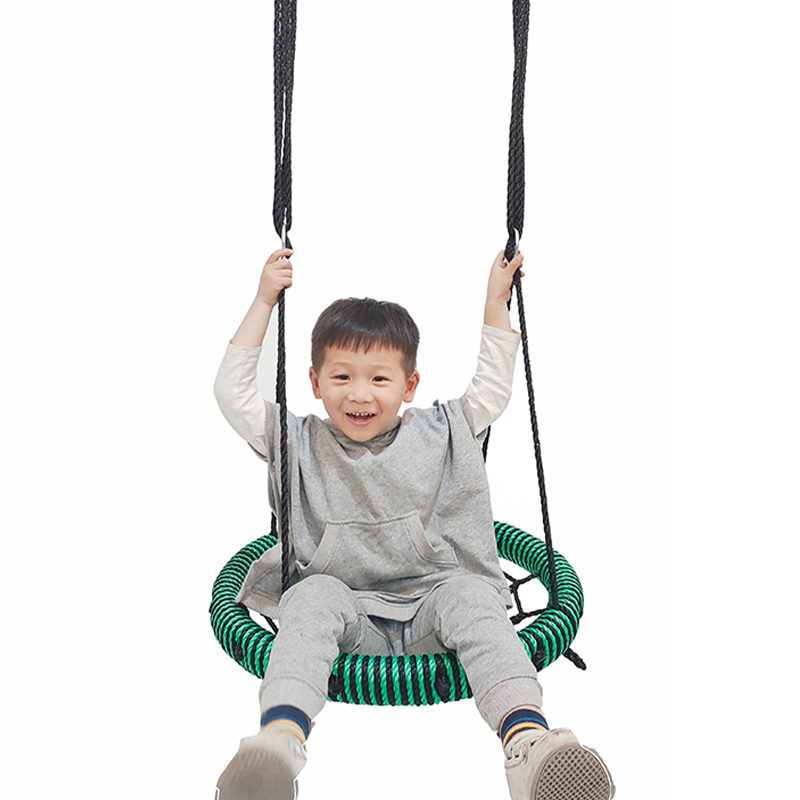
Modern park guidance encourages planners to make playgrounds welcoming for children of different ages and abilities. One of the most effective pieces of equipment for this goal is a nest or saucer swing. Its wide, flat surface lets a child with limited balance lie down, a toddler sit with support, or a parent sit beside a young child. The low entry height removes the challenge that a traditional belt seat creates. A 40-inch giant Oxford saucer swing is a single product that serves this broad range of users. Nest swings also tolerate heavy daily traffic, because the fabric and steel ring are straightforward to inspect and replace when needed.
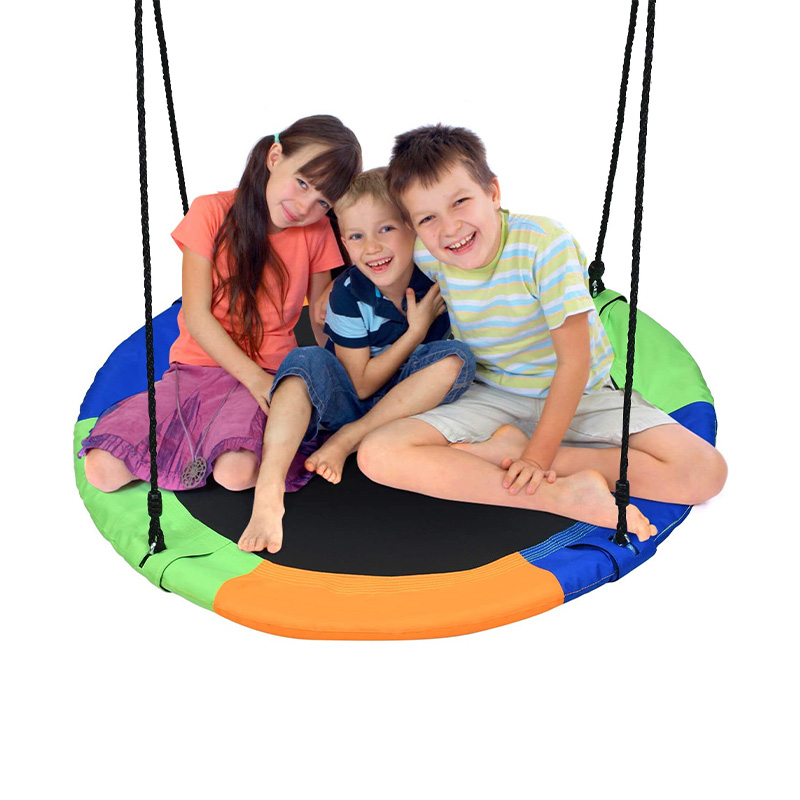 Wholesale 40-Inch Giant Oxford Saucer Swing Manufacturers, CompanyAs a China 40-Inch Giant Oxford Saucer Swing supplier and wholesale 40-Inch Giant Oxford Saucer Swing company, Ningbo Yongxu Industrial P...View Product →
Layout, Fall Zones, and Support Structures
Space planning is where many projects run into problems before the first anchor is installed. Each swing bay needs a fall zone that extends at least twice the suspension height in front and behind the seat. Climbing structures require clearance around the perimeter based on their certified fall height. Pathways must be firm enough for wheelchairs and strollers, and at least some elevated elements need accessible entry points. The support structure also deserves close review. A double bay swing, for example, must resist twisting forces and repeated dynamic loads when both seats are moving. A heavy duty rustproof double swing frame gives a community park a predictable and safe geometry without relying on tree branches, and hot-dip galvanized posts with powder-coated finishes last much longer than lightweight painted alternatives.
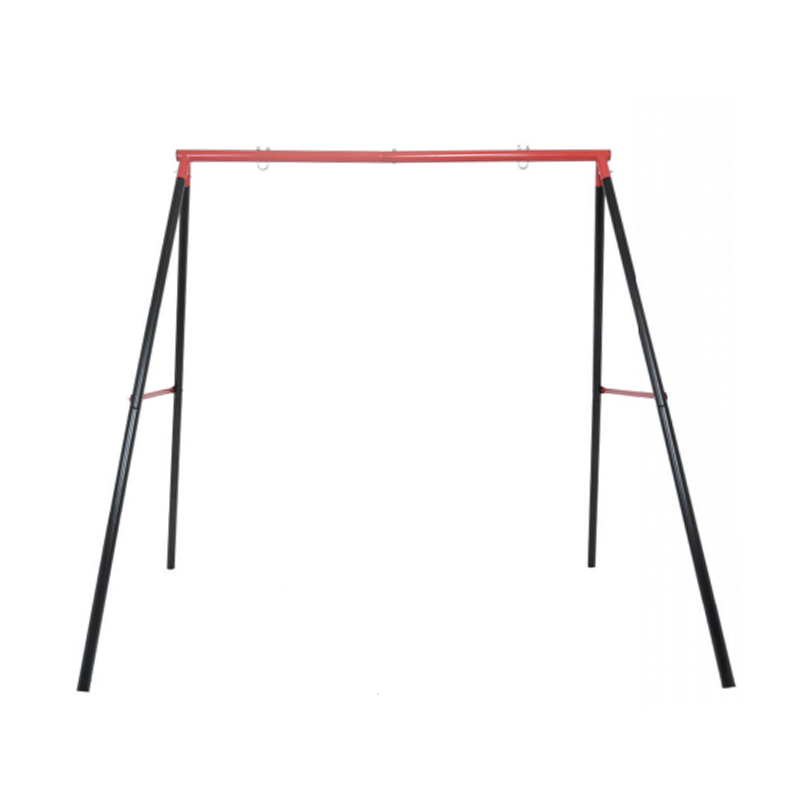 Wholesale Heavy-Duty Rust-Proof Double Swing Fram Manufacturers, CompanyAs a China Heavy-Duty Rust-Proof Double Swing Fram supplier and wholesale Heavy-Duty Rust-Proof Double Swing Fram company, Ningbo Yongxu ...View Product →
Practical Layout Rules
- Keep each swing bay centered inside its own fall zone.
- Position climbers and slides so running routes do not cross.
- Use a unitary impact surface under high-traffic areas.
- Orient shade structures over metal components to reduce summer surface temperatures.
Budget Allocation and Equipment Mix
Facility planners often ask how to spread the budget across different play types. Data from community parks consistently shows that swinging attracts the largest share of users, followed by climbing and sliding. The column chart below shows a recommended budget allocation for a mid-sized neighbourhood park.
The column chart recommends putting about 40 percent of the equipment budget into swings, 30 percent into climbing structures, 20 percent into slides, and 10 percent into accessories. Swings receive the largest share because they offer continuous independent motion and serve the broadest age range. Climbing structures come second because they retain older children who might otherwise lose interest in the park. Slides are essential for younger children but produce a shorter duration of use per visit. This mix is only a starting point; a site near a school may shift more budget toward climbers while a family-oriented neighbourhood may increase the slide share.
Total Cost of Ownership
The lowest bid is rarely the cheapest equipment. Maintenance labour, replacement parts, and early removal all drive the total cost of ownership. The line chart below models two swing structures over a ten-year period: a budget-grade unit and a commercial-grade unit built with documented materials.
The line chart compares cumulative costs for a budget-grade swing structure and a commercial-grade structure. The budget unit starts at about eighteen thousand dollars, while the commercial unit starts at thirty thousand. Between year four and year six, the budget unit develops rusted chains, cracked seats, and loosened fasteners that trigger its first repair cycle. By year seven, the cumulative cost of the budget unit has caught up with the commercial unit. At year ten, the budget structure has cost more overall and still needs a full replacement, whereas the commercial structure still has most of its original components. Finance committees should therefore review the ten-year curve instead of the first-year price.
Comparing Equipment Types with a Radar Chart
Each equipment category has its own strengths and weaknesses. The radar chart below evaluates swings, climbers, and slides on five criteria: durability, safety record, inclusive value, ease of maintenance, and cost efficiency. A score of five is the best possible rating.
Swings score highest on inclusive value because nest and platform seats accommodate users with different mobility levels. Climbers score strongly on durability, since robust metal posts and HDPE decks are simple to construct and last well. Slides offer the easiest maintenance because they have no moving parts and fewer joints to inspect. Slides score lower on inclusive value because transferring a child with limited mobility onto a slide deck is more difficult. The trade-offs visible in the radar chart explain why the best park designs use a balanced mixture, with swings as the centrepiece, climbers for older children, and slides for the youngest visitors.
Working with a Playground Equipment Manufacturer
Most park projects begin with a request for quotation sent to several suppliers. The right partner is not necessarily the one with the lowest unit price, but the one that can document material grades, provide load-rated hardware, and match the visual direction of the park. A factory with in-house injection moulding, metal fabrication, and coating lines can control quality more directly than a trading company can. If the project calls for custom colours, engraved logos, or a specific dimensional change, ask whether the manufacturer supports OEM development from drawings or samples. You can contact our engineering team through the contact page to discuss your project scope and receive a configuration review.
For parks that want a natural and active focal point, a colorful tree climbing rope with platforms is a flexible centrepiece that encourages balance and coordination. Rope elements blend well with landscape planting and provide a different movement pattern from rigid steel structures. Whatever equipment you choose, confirm that spare parts will be available for the full design life, because parts availability is one of the hidden costs of playground ownership.
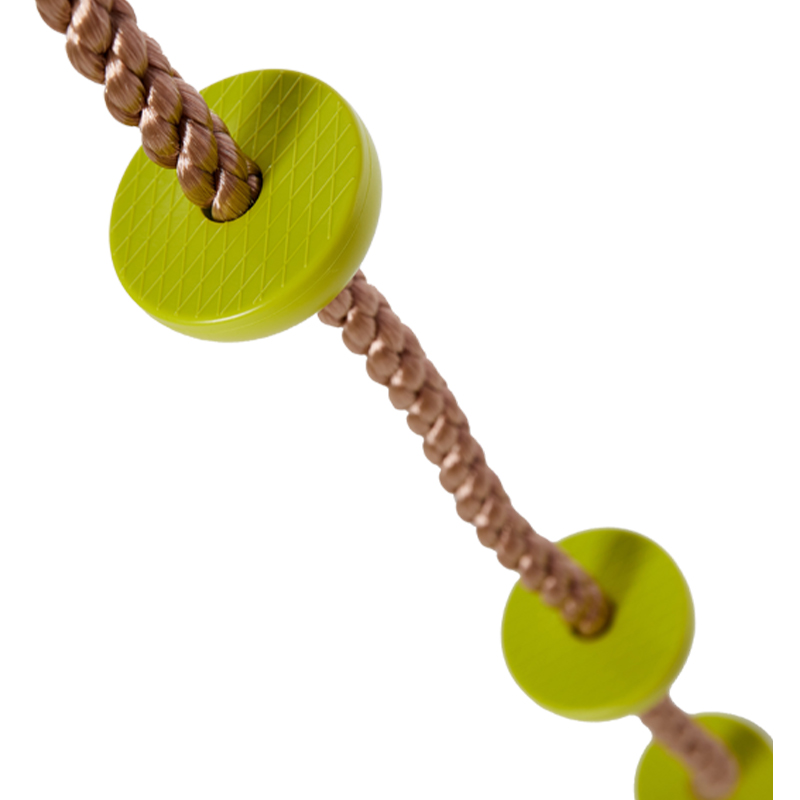 Wholesale Colorful Tree Climbing Rope With Platforms Manufacturers, CompanyAs a China Colorful Tree Climbing Rope With Platforms supplier and wholesale Colorful Tree Climbing Rope With Platforms company, Ningbo Y...View Product →
Inspection and Maintenance
A commercial playground only performs well when it is maintained. Set a schedule based on the manufacturer's instructions and the expected traffic level. Check bolts and S-hooks for loosening, run a hand along chains to detect rough links, and verify that impact surfacing is still at the required depth. Replace worn swing seats before they crack through, not after. Keep a small stock of the components that wear first, including chains, connectors, and seat straps. Preventive maintenance extends the service life shown in the material chart and reduces the risk of injury at the same time.
The message for park planners is straightforward. Buy commercial-grade equipment from a manufacturer that understands the demands of public sites, verify the safety standards and hardware specifications, and spread the budget across a balanced mix of swings, climbers, and slides. The initial price is only one number in a twenty-year equation that also includes maintenance, replacement, and public satisfaction. A well-chosen playground becomes an asset that serves the community every day, and that starts with the right equipment decisions at the specification stage.