 Eng
Eng
 Español
 عربى
عربى Deutsch
 русский
 Français
Content
- 1 The Two Main Types: Plastic Swing Seats vs. Wooden Swing Seats
- 2 Comparing Plastic and Wooden Children's Swing Seats Side by Side
- 3 Children's Swing Seat Designs by Age Group and Developmental Stage
- 4 Suspension Systems: Ropes vs. Chains and Why It Matters
- 5 Safety Standards: EN71 and ASTM Certification Explained
- 6 The Developmental Benefits of Swinging for Children
- 7 Installation Options: Where and How Children's Swing Seats Can Be Fitted
- 8 Key Factors to Consider When Choosing a Children's Swing Seat
- 9 Maintenance and Safety Inspection for Long-Term Use
- 10 Children's Swing Seats for Different Settings: Home, Kindergarten, and Community
- 11 Summary: What Makes a Children's Swing Seat Worth Choosing
Children swing seats and swing chairs are specially designed suspended seating devices built for kids to sit in and swing back and forth, typically installed on outdoor play frames, tree branches, or dedicated swing sets. They come in a wide range of materials, shapes, and configurations — from simple plastic bucket seats for toddlers to wooden plank swings for older children — and are engineered to combine physical play with measurable developmental benefits.
Unlike general outdoor furniture, children's swing seats are purpose-built products subject to strict international safety certifications such as EN71 (European toy safety standard) and ASTM F1148 (American standard for home playground equipment). They are designed for use in homes, kindergartens, community playgrounds, and daycare centers, and are constructed from materials chosen specifically for weather resistance, child safety, and long service life under heavy repetitive use.
In practical terms, the category covers two primary material families — plastic swing seats and wooden swing seats — along with a variety of suspension systems including weatherproof PE ropes and rust-resistant galvanized or stainless steel chains. Understanding what distinguishes a quality children's swing from a basic one requires looking at materials, construction methods, safety credentials, and the developmental value they provide.
The Two Main Types: Plastic Swing Seats vs. Wooden Swing Seats
The children's swing seat market is broadly divided between plastic and wooden options, each with distinct manufacturing approaches, performance characteristics, and ideal use contexts. Choosing between them depends on the child's age, the installation environment, and the priorities of the parent or facility manager.
Plastic Swing Seats: Two Manufacturing Methods and Their Differences
Plastic children's swing seats are produced using one of two primary manufacturing processes, each yielding a product with different properties:
- Blow-molded plastic seats are produced by inflating heated plastic inside a mold, creating a hollow double-wall structure. This method produces seats that are lightweight yet highly impact-resistant, with a slightly textured exterior surface that reduces slipping. Blow-molded seats are the most common type used for toddler bucket swings and full-bucket safety seats, where the enclosed design prevents young children from slipping out.
- Injection-molded plastic seats are produced by injecting molten plastic into a precision mold under high pressure, resulting in a denser, solid-body seat with a smoother, more uniform finish. Injection-molded seats offer excellent dimensional accuracy and are often used for flat plank-style swing seats and contoured saddle seats for older children.
Both plastic types are paired with anti-aging, UV-stabilized suspension systems — either braided PE rope or powder-coated or galvanized steel chain — that resist the degradation caused by prolonged sun exposure and outdoor weathering. High-quality plastic swing seats can maintain their structural integrity and color stability for 5 to 10 years of regular outdoor use when made with UV-resistant high-density polyethylene (HDPE).
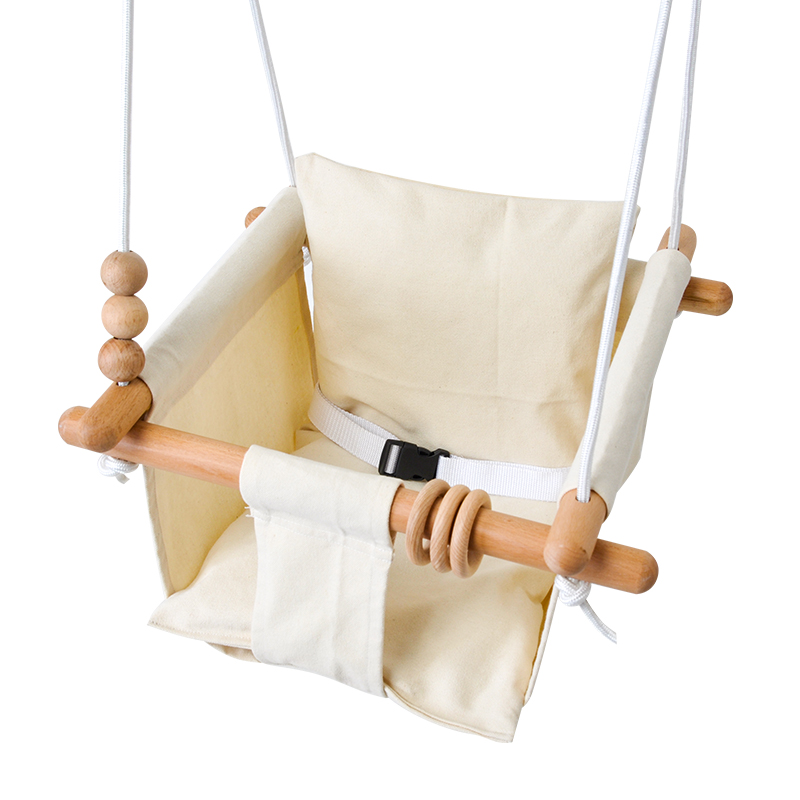
Wooden Swing Seats: Natural Appeal with Engineered Durability
Wooden swing seats offer a natural aesthetic that many parents and educators prefer, particularly for garden settings and nature-inspired play environments. However, raw untreated wood performs poorly outdoors — it cracks, splinters, warps, and rots under repeated exposure to rain and sun. Quality wooden children's swing seats address this through specific material treatments:
- Carbonized (heat-treated) wood is processed at high temperatures without chemical preservatives, causing the wood's cellular structure to harden and become significantly more resistant to moisture absorption, cracking, and insect damage. Carbonized wood has a characteristic warm brown color and retains this resistance throughout its service life without leaching chemicals — an important consideration for children's play equipment.
- Sanded and rounded edges are standard on quality wooden swing seats — all corners and edges are machine-sanded to a minimum radius to eliminate splinter risk. This finishing step is mandatory for EN71 compliance and is one of the most important child safety features of a wooden swing seat.
- Adjustable PE rope suspension systems with a typical adjustment range of 1.2 meters to 2.0 meters allow the same wooden seat to be fitted at different heights as the child grows, or to accommodate installation on both low tree branches and tall dedicated swing frames.
Comparing Plastic and Wooden Children's Swing Seats Side by Side
The table below provides a structured comparison of the key characteristics of plastic and wooden children's swing seats across the most important purchase and performance criteria.
| Category | Plastic Swing Seat | Wooden Swing Seat |
|---|---|---|
| Primary material | HDPE or PP plastic | Carbonized hardwood or pine |
| Weight | Lightweight (0.5–2 kg typical) | Heavier (1.5–4 kg typical) |
| Weather resistance | Excellent — fully waterproof | Good — heat-treated wood resists moisture |
| Surface safety | No splinters; smooth or textured | Sanded smooth; splinter-free when properly finished |
| Maintenance required | Minimal — wipe clean | Periodic re-oiling or sealing recommended |
| Eco-friendliness | Recyclable HDPE versions available | Natural material; chemical-free heat treatment |
| Aesthetic | Bright colors; modern playground look | Natural, warm; suits garden and nature settings |
| Best age range | 6 months – 8 years (varies by design) | 3 years – 12 years (plank styles) |
| Typical load capacity | 50–100 kg depending on model | 80–150 kg for hardwood plank models |
| Installation flexibility | Frame or tree; fixed rope/chain length | Adjustable PE rope 1.2–2.0 m height |
Children's Swing Seat Designs by Age Group and Developmental Stage
Not all swing seats are suitable for all ages. Children at different developmental stages have fundamentally different support needs, motor capabilities, and safety requirements. Using a swing designed for the wrong age group is one of the most common causes of playground injuries. Here is how the major swing seat designs map to age groups:
Infant Bucket Swings (Ages 6 Months – 2 Years)
Infant bucket swings have a fully enclosed bucket-shaped seat with leg holes and a high back that surrounds the child on all sides. The enclosed design prevents the baby from leaning forward, sliding sideways, or slipping through the seat. These are typically made by blow-molding and feature a crotch strap or front bar to further secure the child.
Infant bucket swings should only be used with a responsible adult present at all times. Standard infant bucket swings are rated for children who can hold their head up independently, typically from 6 months, up to a maximum weight of approximately 25 to 30 kg. These swings are among the most popular first outdoor play items for young families.
Toddler and Preschool Bucket Swings (Ages 2–5 Years)
As children grow past infancy, they transition to larger bucket seats with a slightly more open design that still provides back and side support but allows greater freedom of movement. These seats typically have a T-bar or safety strap across the front to prevent the child from climbing out while in motion, but are less enclosed than infant versions.
Toddler bucket swings are rated for children up to approximately 35 to 40 kg and are the most widely used swing type in kindergarten and daycare settings, where they provide a safe swinging experience for children who are developing their sense of balance but cannot yet be trusted to maintain a safe grip on an open plank swing.
Flat Plank Swings (Ages 5 Years and Up)
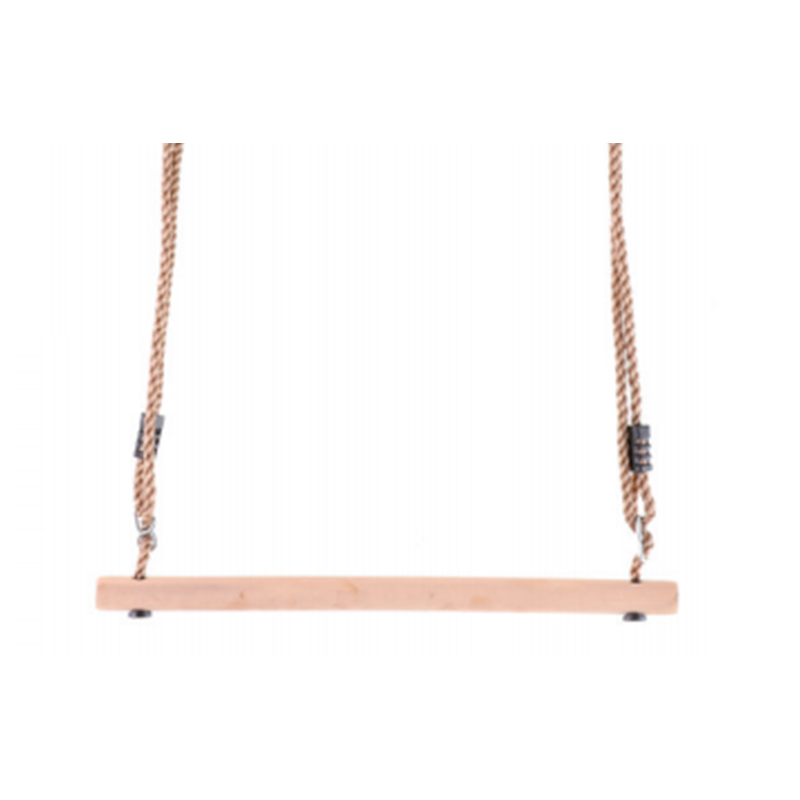
The classic flat plank swing — a horizontal board suspended by two ropes or chains at the corners — is the most traditional and versatile swing design. Available in both plastic and wood, flat plank swings require the child to actively grip the ropes or chains and engage their core and leg muscles to maintain their position and generate momentum.
This engagement makes flat plank swings significantly more developmental than enclosed bucket seats — they demand greater balance, coordination, and upper body strength, and allow children to learn pumping technique independently. Wooden plank swings are particularly popular for home garden installation and are often rated to 100 kg or more, allowing older children and even adults to use them.
Saddle and Contoured Swing Seats
Saddle-style swing seats are contoured with a raised front and curved sides that allow the child to straddle the seat, providing additional lateral support compared to flat planks while still requiring active balance. These are popular for children in the 4 to 10 year age range who have outgrown bucket swings but still benefit from a seat with some built-in support structure.
Disc and Nest Swings
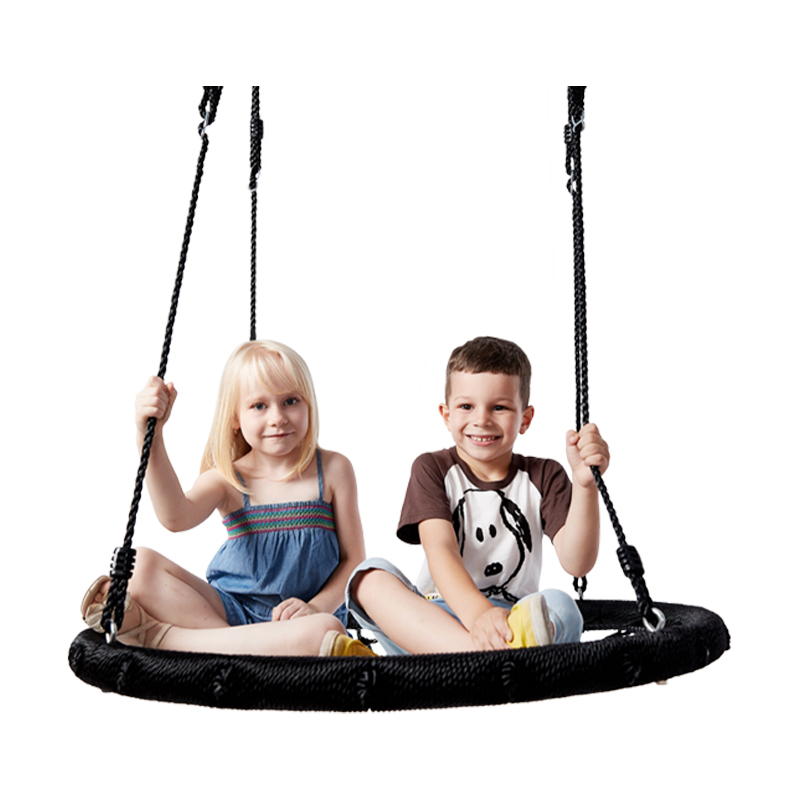
A growing category within children's swing seating is the disc swing — a round platform suspended from a single central point that rotates as well as swings. Disc swings can accommodate multiple children simultaneously and allow movement in 360 degrees rather than just a forward-back arc. Similarly, nest swings — large bowl-shaped fabric or rope seats — allow multiple children to sit or lie together, encouraging cooperative play.
These multi-directional swing types provide different sensory and vestibular stimulation compared to traditional arc-motion swings and are particularly valued in sensory play and occupational therapy contexts.
Suspension Systems: Ropes vs. Chains and Why It Matters
The suspension system — the ropes or chains connecting the swing seat to its mounting point — is as important as the seat itself in determining a swing's safety, durability, and suitability for a given installation environment.
PE Rope Suspension
Polyethylene (PE) rope is the most common suspension material for home-use and garden children's swings. High-quality PE rope for swing applications is manufactured with UV stabilizers that prevent the polymer from breaking down under prolonged sun exposure — a critical requirement given that outdoor swings are exposed to direct sunlight for months at a time.
PE rope suspension systems offer several advantages for children's swings:
- Adjustability: Rope can be easily knotted or re-threaded to change the swing height, with a typical adjustment range of 1.2 to 2.0 meters from the hanging point to the seat.
- Child safety: Rope does not pinch fingers in the same way that chain links can. For young children who may grasp the suspension while swinging, rope is generally considered the safer option.
- Tree installation compatibility: Rope can be tied directly to tree branches using appropriate knots (such as a bowline) without requiring permanent hardware.
- Lightweight: PE rope adds minimal overall weight to the swing assembly, an advantage when removing the seat seasonally for storage.
Steel Chain Suspension
Galvanized or stainless steel chains are the standard suspension choice for commercial-grade playground equipment and heavier-duty home swing sets. Quality swing chains are manufactured from zinc-plated or hot-dip galvanized steel to prevent rust, or from grade 304 stainless steel for the highest corrosion resistance in coastal or high-humidity environments.
The key advantages of chain over rope include:
- Higher load capacity: A well-specified swing chain has a working load limit far exceeding anything a child could generate — typically rated to 500 kg or more breaking strength for standard commercial playground chain.
- Longevity: Properly treated steel chain will outlast PE rope in outdoor conditions, with a service life of 10 to 20 years before replacement is needed.
- Visual inspection ease: Chain wear and deformation is easy to spot during routine maintenance inspections; rope internal degradation can be harder to detect.
A safety consideration specific to chains is the risk of finger entrapment in chain links. Quality children's swing chains address this with plastic or rubber coating over the chain in the areas where children might grasp — this eliminates the pinch hazard while retaining the structural strength of the steel core.
Safety Standards: EN71 and ASTM Certification Explained
Safety certification is one of the most important factors to verify when purchasing children's swing seats. Two international standards are most relevant to this product category:
EN71 — European Toy Safety Standard
EN71 is the European Union's mandatory toy safety standard, applicable to products intended for use by children under 14 years of age. For swing seats, the relevant portions of EN71 cover:
- Mechanical and physical properties: Testing for sharp edges, protruding points, and small parts that could cause injury. All edges and surfaces accessible to children must meet defined safety radii and surface finish requirements.
- Chemical safety (EN71-3): Limits on migration of hazardous elements — including lead, cadmium, chromium, and other heavy metals — from surface coatings and materials that children may contact.
- Flammability: Materials used in construction must not ignite readily or sustain combustion beyond defined limits.
EN71 certification is mandatory for selling children's products within the European Economic Area and is recognized as a high-quality safety benchmark globally. Products bearing the CE mark with EN71 compliance have been tested and certified by an accredited laboratory.
ASTM F1148 — American Standard for Home Playground Equipment
ASTM F1148 is the American Society for Testing and Materials standard specifically covering home playground equipment, which includes swing sets and swing seats for residential use. Key requirements under ASTM F1148 include:
- Entrapment hazard testing: Openings in swing seats, frames, and hardware must not trap a child's head, neck, or torso. Specific probe dimensions are used to simulate a child's head and assess entrapment risk.
- Structural load testing: Swing components must withstand defined static and dynamic load tests without failure, simulating the forces generated by children of the intended age range during normal use.
- Suspension system requirements: Ropes, chains, and connectors must meet minimum strength and fatigue specifications and must not present entanglement or entrapment risks.
For commercial-grade playground equipment in public parks and schools, the related standard ASTM F1292 (impact attenuation of surfacing materials) and ASTM F1487 (public playground equipment) apply in addition to F1148. When purchasing for institutional use, verifying compliance with both home and commercial standards provides the highest safety assurance.
The Developmental Benefits of Swinging for Children
The significance of children's swing seats extends far beyond simple entertainment. Research in child development and pediatric occupational therapy has consistently identified swinging as an activity with substantial, measurable developmental benefits across multiple domains of a child's growth.
Vestibular Sensory Development
The vestibular system — housed in the inner ear — is responsible for a child's sense of balance, spatial orientation, and the perception of gravity and movement. Swinging provides one of the most effective and natural forms of vestibular stimulation available to young children. The rhythmic, repetitive forward-and-backward motion activates the vestibular receptors in a controlled, predictable way that helps the brain learn to process and integrate movement information.
Occupational therapists frequently prescribe swinging as a therapeutic activity for children with sensory processing difficulties, autism spectrum disorder, and developmental coordination disorder. The calming, organizing effect of rhythmic vestibular input is well documented — many children who are dysregulated or overstimulated can achieve a calmer, more focused state after 10 to 15 minutes of gentle swinging.
Core Strength and Postural Control
Maintaining a seated position on a moving swing — especially on a flat plank swing without back support — requires constant, active engagement of the core muscles. Children learn to shift their weight, tighten their abdominal muscles, and use their arms and legs for balance without conscious awareness of doing so. Over weeks and months of regular use, this develops core strength, postural stability, and body awareness that transfer to other physical activities including running, jumping, and sports.
Proprioception and Motor Planning
Proprioception is the body's sense of its own position in space. When a child learns to pump a swing — coordinating leg extension and flexion with the arc of movement to maintain and increase momentum — they are engaging in a complex motor planning task. This self-generated pumping action, typically mastered between ages 5 and 7, represents a significant motor learning milestone that requires the integration of timing, coordination, rhythm, and proprioceptive feedback.
Cognitive and Emotional Benefits
Beyond the physical domain, swinging provides important cognitive and emotional benefits:
- Attention and focus: The repetitive, rhythmic sensory input of swinging has been shown to improve sustained attention in children, both immediately after the activity and as a cumulative effect of regular practice.
- Emotional regulation: The calming effect of vestibular input helps children manage emotional arousal — many children instinctively seek swinging when anxious or overwhelmed, and caregivers and therapists use it deliberately for this purpose.
- Confidence and risk assessment: Learning to control a swing, push higher, and eventually jump off at the right moment builds a child's confidence in their physical abilities and their understanding of manageable risk.
- Social skills: Taking turns on a swing, pushing a friend, and negotiating swing time teaches cooperation, patience, and social reciprocity in a natural, enjoyable context.
Installation Options: Where and How Children's Swing Seats Can Be Fitted
One of the practical advantages of modern children's swing seats is their flexibility in installation. They can be fitted in several different ways depending on the available outdoor space and the type of swing seat purchased.
Dedicated Swing Frame Installation
The most common residential installation method is attachment to a dedicated A-frame or portal-frame swing set, either freestanding or ground-anchored. Swing frames are available in metal (powder-coated steel or aluminum) and wood (pressure-treated timber), with crossbar heights typically ranging from 1.8 meters to 3.0 meters for residential use.
Swing seats are attached to the frame crossbar via S-hooks, quick-links, or dedicated swing hangers. The swing hanger hardware is a critical safety component — it must be rated for dynamic loads (not just static weight) and should be specifically designed for swing use, not improvised from general hardware store components.
Tree Branch Installation
Wooden swing seats with adjustable PE rope suspension are well-suited to installation on suitable tree branches — a traditional and appealing option for garden settings. Safe tree installation requires:
- A horizontal branch with a minimum diameter of 20 cm (8 inches) to provide adequate structural support
- A branch that is healthy, without visible decay, cracks, or dead wood
- Suspension ropes attached using tree-friendly straps (not wire or metal that would damage the bark and girdle the branch) rated to at least 5 times the expected load
- Clearance of at least 2 meters on all sides of the swing arc from walls, fences, and other structures
Ceiling and Beam Installation (Indoor/Covered Outdoor)
For covered patios, pergolas, or indoor playrooms, swing seats can be mounted from ceiling joists or structural beams using purpose-made ceiling swing brackets. This is particularly popular for sensory swing installations and baby bucket swings in nurseries. Ceiling installation requires that the mounting point is fixed to a structural member — not just drywall or a non-load-bearing surface — capable of supporting at least 4 times the maximum expected dynamic load.
Key Factors to Consider When Choosing a Children's Swing Seat
With a wide variety of options available, selecting the right swing seat for a specific child and installation situation requires careful consideration of several factors. The following checklist covers the most important decision criteria:
Age and Weight Compatibility
Always verify that the swing seat's stated age range and maximum weight capacity match the child who will be using it. Never use an infant bucket swing for a child who has exceeded its weight limit — the structural integrity of the seat and its attachment points is rated specifically to the load ranges tested during certification. Using an undersized seat with an overweight child can cause sudden failure with no warning.
Safety Certification Verification
Look for explicit EN71 and/or ASTM certification marks on the product and its packaging. Reputable manufacturers provide test certificates from accredited third-party laboratories upon request. Be cautious of products that claim "meets safety standards" without providing specific certification documentation — this phrasing does not guarantee third-party testing.
Material Quality and Finish
For plastic seats, check that the material is specified as HDPE or PP with UV stabilization — not generic "plastic." For wooden seats, confirm that the wood has been heat-treated or otherwise weatherproofed, and run a hand over all surfaces and edges to check for any roughness or splinter risk before installation.
Suspension System Quality
Inspect rope or chain for UV stabilization (rope) or rust-resistant coating (chain). Check all connecting hardware — carabiners, S-hooks, quick-links — for appropriate grade ratings and ensure that closing mechanisms cannot be inadvertently opened by a child during play. Hardware on children's swings should be grade 316 stainless steel or hot-dip galvanized steel for outdoor applications.
Installation Environment
Consider whether the swing will be used outdoors year-round, seasonally stored, in a coastal environment (which requires higher corrosion resistance), or indoors. A swing that will remain outdoors through winter in a high-rainfall climate has different material requirements than one used in a dry, temperate garden.
Maintenance and Safety Inspection for Long-Term Use
Even the highest-quality children's swing seat requires regular inspection and maintenance to remain safe throughout its service life. Outdoor use, UV exposure, and the cumulative stress of dynamic loading all gradually affect the structural integrity of every component. A routine inspection schedule is the single most important thing a parent or facility manager can do to prevent swing-related injuries.
Recommended Inspection Schedule
| Inspection Item | Frequency | What to Look For |
|---|---|---|
| Rope condition | Monthly | Fraying, UV discoloration, stiffness, knot integrity |
| Chain condition | Monthly | Rust spots, stretched or deformed links, coating wear |
| Plastic seat surface | Monthly | Cracks, sharp edges from UV degradation, fading |
| Wooden seat surface | Monthly | Splinters, cracks, darkening (moisture), surface roughness |
| Hardware (hooks, links, hangers) | Monthly | Rust, deformation, open or bent closures, loose fasteners |
| Mounting point (frame/tree/ceiling) | Every 3 months | Loosening bolts, frame rust or corrosion, wood decay at joints |
| Full structural assessment | Annually | Complete disassembly and inspection of all load-bearing components |
| Wooden seat re-oiling | Annually | Apply outdoor wood oil or sealant to maintain moisture resistance |
Any swing component showing signs of structural damage, significant wear, or material degradation should be removed from service immediately and replaced before the swing is used again. The cost of replacement hardware or a new seat is trivial compared to the consequences of a component failure during use.
Children's Swing Seats for Different Settings: Home, Kindergarten, and Community
Children's swing seats are designed and specified differently depending on the setting in which they will be used. Understanding these differences helps buyers choose the appropriate product for their specific application.
Home and Garden Use
Home use swing seats prioritize ease of installation, aesthetic appeal in a garden setting, and value for money alongside safety. Wooden plank swings with adjustable PE ropes are highly popular for home gardens, offering a natural look that complements outdoor plantings. Home swing sets typically accommodate 1 to 2 children simultaneously and are designed for supervised use with parental oversight available.
Kindergarten and Daycare Settings
In kindergarten and daycare environments, swing seats see significantly higher use frequency with many different children throughout the day, placing greater demands on durability and hygiene. Plastic bucket swings are preferred in these settings for their ease of cleaning — simple wipe-down with disinfectant solution between users — and their enclosed design that suits the 2 to 5 year age group that predominates in early childhood facilities.
Institutional settings typically require EN71 certification as a minimum, and many European early childhood facilities require compliance with the additional standard EN 1176 (playground equipment for public use), which has stricter requirements for entrapment hazards, structural durability, and fall height management than EN71 alone.
Community Playgrounds
Public playground swing equipment must meet the most demanding specifications of all three settings. Community playground swings are subject to vandalism, unsupervised use across a wide age range, and exposure to all weather conditions year-round without seasonal removal. Steel chain suspension with coated links, heavy-gauge steel frames with anti-rust treatment, and bucket seats with maximum structural robustness are standard in this context. Fall zone surfacing beneath playground swings — typically rubber mulch, engineered wood fiber, or poured-in-place rubber — is mandatory in most jurisdictions, with minimum depth and extent specified by ASTM F1292 and EN 1177.
Summary: What Makes a Children's Swing Seat Worth Choosing
Children's swing seats and swing chairs are far more than simple playground accessories. They are carefully engineered play and development tools that, when properly selected and maintained, deliver lasting physical, cognitive, and emotional benefits to children from infancy through early adolescence.
The key attributes that distinguish a quality children's swing seat are:
- Verified safety certification — EN71 and/or ASTM tested and documented by an accredited laboratory
- Age-appropriate design — enclosed bucket seats for infants and toddlers, open plank seats for older children
- Durable, eco-conscious materials — UV-stabilized HDPE plastic or heat-treated wood, paired with weatherproof PE rope or rust-resistant chain
- Appropriate load capacity — clearly stated maximum weight that exceeds the actual weight of the intended user with a meaningful safety margin
- Installation flexibility — adjustable rope length or compatible hardware for frame, tree, and ceiling mounting
- Ease of maintenance — smooth, cleanable surfaces and corrosion-resistant hardware that can be inspected and replaced as needed
When these qualities are combined, a children's swing seat becomes an investment that pays dividends in a child's development for years — delivering daily doses of vestibular stimulation, motor skill building, outdoor physical activity, and the simple, irreplaceable joy of flight that has made swings one of humanity's most enduring gifts to childhood.