 Eng
 Español
 عربى
 Deutsch
 русский
 Français

Content
- 1 What the Net Is Being Asked to Do
- 2 Specifications That Decide Whether the Panel Passes Inspection
- 3 Hardware and Anchoring: Where Most Installations Fail
- 4 Checking a Supplier Before the First Batch
- 5 Inspection Routine After Handover
- 6 Fitting the Net Into the Rest of the Play Area
- 7 Getting a Quote That Reflects the Real Job
An open-sided play tower standing 2.5 m above the ground, a climbing frame with a gap between two platforms, a raised walkway in a public park: these are the places where a buyer usually asks for cable net. The request often arrives as a photo and a span width, and the helpful answer is not a price per square metre. It is a specification, covering rope construction, mesh opening, coating, edge cable, anchor type, and the inspection routine that keeps the net correctly tensioned after two seasons of outdoor use.
What the Net Is Being Asked to Do
Cable net on a playground normally carries one of three jobs, and each one points to a different set of numbers.
- Containment: the net stops a child from passing through an opening at height. Here the mesh geometry and the stiffness of the panel matter more than its appearance.
- Climbing surface: the net is meant to be gripped, stepped on and pulled. Rope diameter, hand comfort and the way the panel is fixed to the frame become the priorities.
- Visual barrier: the net closes off a plant room, a gap under a walkway or a service area where no climbing is intended. A lighter construction is usually enough, provided the fixings cannot be undone by hand.
One point causes more site problems than any other: a cable net is a barrier, not a soft landing. It prevents a body from passing through an opening. It does not absorb the energy of a fall, and it should never be treated as a substitute for the impact-attenuating surface below the structure. Designers working to EN 1176 or ASTM F1487 treat the net and the surfacing as two separate systems, and inspectors do the same.
Specifications That Decide Whether the Panel Passes Inspection
Most disputes about cable net come down to four figures written on the drawing: rope diameter, mesh opening, coating thickness and edge cable size. The table below shows how those choices usually line up in practice.
| Rope construction | Typical mesh opening | Usual role | What to confirm before ordering |
|---|---|---|---|
| 3 mm stainless steel, 7x7 strand | 60 x 60 mm to 80 x 80 mm | Guard panels and infill on play towers | Minimum breaking load per rope, grade of stainless steel, edge termination method |
| 4 mm galvanised or stainless, PVC coated | 80 x 80 mm to 100 x 100 mm | Climbing panels and larger spans | Coating adhesion, colour fastness, salt spray test hours |
| 6 mm rope with 8 mm edge cable | 100 x 100 mm and wider | Long spans, high-tension perimeter nets | Turnbuckle take-up length, post spacing, footing design |
Three details deserve attention beyond that table. First, mesh size is a safety dimension, not a style choice. Flexible openings should either be small enough to reject a head probe or large enough for a body to pass through freely, because an opening that admits a head but grips it is the classic entrapment risk. Second, rope construction controls stiffness and fatigue life. A 7x7 strand rope is compact and holds tension well, while a 7x19 rope is more flexible and better suited to panels that flex under climbing loads. Third, the perimeter matters as much as the field. A net without a properly terminated edge cable, thimbles and clamps will sag at the corners, and sagging corners are where clamps fatigue and strand ends start to show.
Hardware and Anchoring: Where Most Installations Fail
The net is rarely the weak point. The connection between the net, the frame and the ground decides whether the panel stays taut and safe.
A workable sequence on site is to set the posts or frame first, verify the diagonals and the finished opening size, and only then measure for the net. Panels ordered from a nominal drawing rather than a site measurement tend to arrive long or short, and a short panel forces the installer to over-tension the turnbuckles, which loads the clamps far beyond their intended working range.
Leave adjustable take-up in the system: 50 mm to 100 mm of turnbuckle travel is a common allowance, enough to re-tension after the first winter and again once the structure has settled. Use thimbles at every eye termination so the rope bears on a curved surface, and use clips or swaged fittings that match the rope diameter exactly rather than the nearest size in the van.
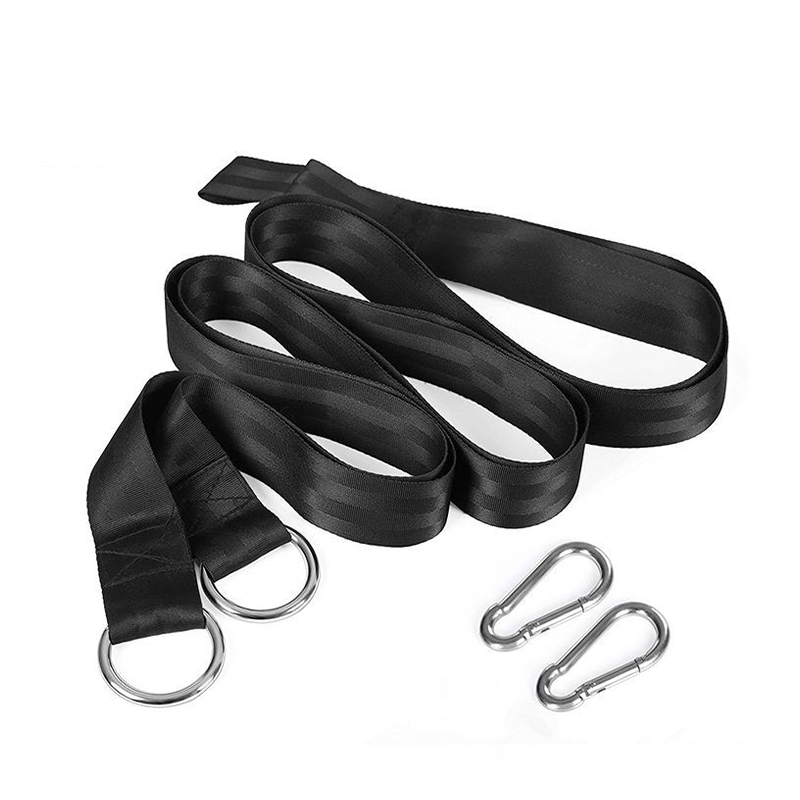 High-Strength Nylon Suspension Strap for Hanging EquipmentNylon strap for swings, hammocks and climbing nets, offered in three anti-slip textures and customizable sizes; worth checking for suspension assemblies.View Product →
For the ground connection, the choice between an expansion bolt, a cast-in anchor and a driven ground anchor follows the base material. Concrete slabs take expansion bolts, timber decks take through-bolts with backing plates, and soil or grass areas need a driven anchor with adequate embedment depth and a plate that spreads load. Whichever is used, the anchor should be specified together with the post, not chosen by the installer on the day.
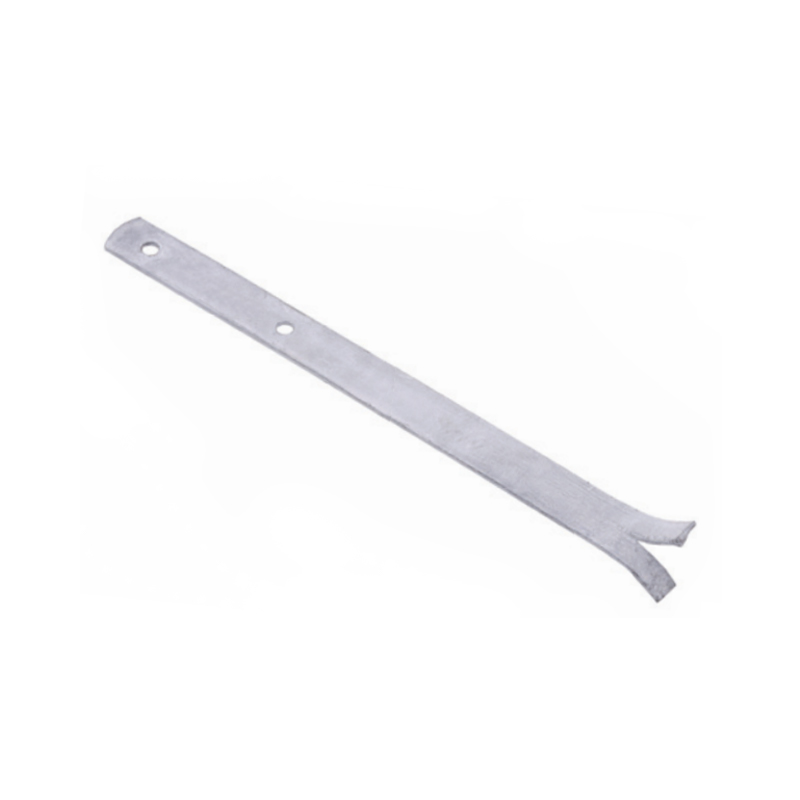 Hot-Dip Galvanized Split Ground Anchor for Wooden Play StructuresGalvanized steel anchor embedded in concrete to stabilize wooden swing, climbing tower or playhouse frames; relevant when specifying ground connections with posts.View Product →
Checking a Supplier Before the First Batch
Wire rope is a commodity, but a finished net panel is not. Two suppliers can quote the same mesh size and deliver panels that behave very differently after a year outdoors, so the verification work belongs before the purchase order.
- Ask for the mill certificate for the wire, showing grade and minimum breaking load, and match it to the rope actually used in the sample.
- Request a salt spray report for the coated version, and note the test hours rather than the word "tested".
- Agree tolerances in writing. A panel dimension tolerance of plus or minus 10 mm and a mesh opening tolerance of a few millimetres is realistic for hand-finished work; zero tolerance is not.
- Ask how the edge is terminated and whether spare clamps, thimbles and a short length of rope are supplied with each shipment. Maintenance crews lose fittings, and a matching spare saves weeks.
- Inspect a production sample panel, not only a showroom piece, and check for uniform tension across the field, clean cut ends and consistent coating thickness.
Inspection Routine After Handover
A net that was perfect at handover can be unsafe after one busy season. A short monthly walk-through covers most of the risk.
- Feel the tension across the panel. Local softness points to a slipped clamp or a stretched section.
- Look at every clamp and swage for strand ends, cracking or corrosion staining.
- Check turnbuckles for remaining travel. A turnbuckle at the end of its thread cannot be re-tensioned.
- Inspect anchors and post bases for movement, cracking around the footing or loose nuts.
- Record the date and findings, because the maintenance log is often the first document an inspector asks for.
Fitting the Net Into the Rest of the Play Area
Fall protection netting rarely stands alone. It usually sits beside a climbing route, a slide exit or a raised deck, and the transition between those elements is where children actually move. A panel that ends 200 mm short of a platform edge, or a climbing net that starts where the guard net finishes, creates exactly the kind of gap the containment was meant to close.
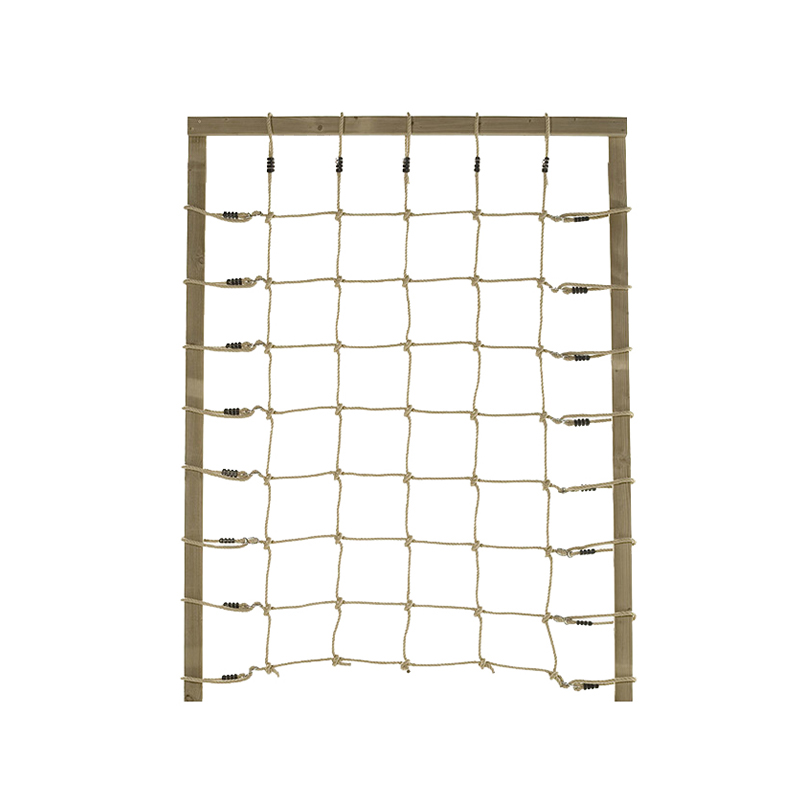 Hand-Woven PE Climbing Net for Children’s Play AreasHand-woven polyethylene climbing net with adjustable buckles, 90 kg limit and 150×200 cm surface; relevant where climbing and containment layouts meet.View Product →
When the same area combines climbing and containment, it helps to plan the net layout as one system with the frame, the fall height and the traffic routes drawn on the same plan. Our notes on what makes a safe and durable climbing system for kids cover the design side of that decision in more detail.
Getting a Quote That Reflects the Real Job
The most useful enquiry includes the finished opening dimensions, the height above the surface, the intended role of the panel, the standard being applied, the base material for the anchors and the required coating colour. With those six items, a manufacturer can propose a rope construction, mesh size and fixing set that will still be serviceable after several seasons outdoors, rather than a panel that merely matches a photograph. If you are working through a project specification, send the drawing and site measurements to our team and we will confirm the net build and hardware list against them.