 Eng
Eng
 Español
 عربى
عربى Deutsch
 русский
 Français
Content
- 1 What ADA Compliance Really Means for a Playground Surface
- 2 The Six Surface Types That Meet Both Standards
- 3 Lifecycle Costs: What You Actually Pay Over Ten Years
- 4 Accessibility in Practice: Maneuverability and Firmness
- 5 How Surface Choice Interacts with Equipment and Fall Zones
- 6 Installation and Site Preparation Tips That Protect Compliance
- 7 Final Recommendations
Last spring, a school facilities director in Ohio called us about a playground that was scheduled for resurfacing. The existing engineered wood fiber had compacted into hard crusts, the surface no longer drained properly, and a parent using a wheelchair had stopped using the accessible route entirely. The director needed a surface that would pass the Americans with Disabilities Act accessibility review and the ASTM F1292 impact test at the same time, with a budget that could not stretch much further.
The first conclusion to keep in mind: poured-in-place rubber is the most reliable way to guarantee ADA compliance and low maintenance, while engineered wood fiber is the best budget choice when your crew has the time and staff to maintain it. Rubber tiles, bonded rubber, rubber mulch, and synthetic turf all sit between these two and fit specific conditions. Your decision comes down to four variables: fall height, site drainage, maintenance capacity, and the total cost over the expected life of the playground.
What ADA Compliance Really Means for a Playground Surface
When installers describe a surface as ADA compliant, they are saying that it satisfies two separate requirements at the same time.
First, the surface must be firm, stable, and slip-resistant on all accessible routes, as required by the 2010 ADA Standards for play areas. An accessible route must be at least 36 inches wide, and it must allow a wheelchair user to travel without excessive physical effort. Second, the surface must pass the ASTM F1951 accessibility test, which measures the propulsion force needed to move an instrumented wheelchair across the surface. Loose sand, pea gravel, and unbound soil normally fail this test because the wheels dig in and create rolling resistance.
The third requirement is ASTM F1292, and it exists independently of accessibility. This standard measures impact attenuation by dropping an instrumented headform onto the surface from a height known as the critical fall height. The recorded Head Injury Criterion must stay below 1,000 for the surface to be approved for that fall height. Compacted asphalt passes accessibility but fails impact testing completely, which is why engineered materials are required under play equipment.
ADA compliance is therefore not a single certificate. It is a combination of test results from F1951 and F1292 applied to a specific installation, at a specific depth, on a specific base. Always ask the supplier for test reports that name the exact depth and configuration you plan to install.
The Six Surface Types That Meet Both Standards
Only a handful of surface systems consistently pass both F1951 and F1292. The table below summarizes the main options used in commercial playgrounds across the United States.
| Surface type | ADA accessible route | Typical max fall height | Installed cost per sq ft | Maintenance level | Expected service life |
|---|---|---|---|---|---|
| Poured-in-place rubber | Yes, when installed correctly | 12 ft at 6 in depth | 15-25 USD | Low | 15-20 years |
| Rubber tiles | Yes | 10 ft at 3.5 in depth | 10-18 USD | Low to moderate | 10-15 years |
| Bonded rubber | Yes | 10 ft at 3-4 in depth | 12-20 USD | Low | 10-15 years |
| Engineered wood fiber | Yes, only with regular upkeep | 12 ft at 12 in depth | 4-8 USD | High | 2-5 years before renewal |
| Rubber mulch | Yes, only with regular upkeep | 10 ft at 9 in depth | 6-10 USD | Moderate | 3-6 years before renewal |
| Synthetic turf with shock pad | Yes | 10 ft with shock pad | 8-15 USD | Moderate | 8-12 years |
Each of these surfaces has a different character in practice. Poured-in-place rubber is a seamless rubber mat formed on site. Rubber tiles are factory-made panels installed over a prepared base; they offer the same firmness and can be replaced individually when damaged. Bonded rubber is rubber granules fused with polyurethane and is often the least expensive bound option. Engineered wood fiber is a loose-fill wood product that needs regular raking, decompaction, and topping-up. Rubber mulch resists displacement better than wood but still needs ongoing attention. Synthetic turf with a shock pad provides a natural appearance and consistent traction, while requiring cleaning and infill management in high-traffic areas.
Initial installed cost per square foot, mid-range US market quotes
Initial installed cost is the first number every buyer sees, but it is also the most misleading. The chart shows typical installed cost per square foot in US dollars from mid-range commercial quotes. Poured-in-place rubber sits at the top at about 20 dollars, while engineered wood fiber is often installed for as little as 5 dollars. Rubber tiles and bonded rubber cost roughly twice as much as loose wood fiber. The problem is that a low install price does not tell you what the surface will cost in year six, because loose-fill materials need annual topping-up and periodic replacement.
Lifecycle Costs: What You Actually Pay Over Ten Years
To compare surfaces fairly, track cumulative costs over a ten-year service life, including the initial install, annual maintenance, and projected replacement events. The line chart below compares poured-in-place rubber, rubber tiles, and engineered wood fiber, the three most frequently specified systems in public bids.
Cumulative cost per square foot over 10 years
Engineered wood fiber Rubber tiles Poured-in-place rubber
Three patterns stand out from this chart. Poured-in-place rubber starts as the most expensive surface but has the flattest cumulative curve, because maintenance is limited to cleaning and small patch repairs. Rubber tiles stay close to poured-in-place rubber and remain below it across the decade when isolated tile replacements are handled correctly. Engineered wood fiber begins at roughly one-third of the cost of its bound competitors but climbs steadily; by year eight or nine it overtakes rubber tiles, and by year ten it approaches poured-in-place rubber. The precise crossing point depends on labor rates and installed depth, but the direction of the trend is consistent across regional cost studies. For a public playground used every day, the low first cost of wood fiber is usually erased by the tenth year.
Accessibility in Practice: Maneuverability and Firmness
ADA compliance is decided the moment a wheelchair user tries to cross the surface. A poured-in-place rubber surface offers a continuous, smooth path with no seams between tiles. Rubber tiles are nearly as good, provided the base below them does not shift and the seams stay flush. Engineered wood fiber is the most difficult loose-fill surface to keep accessible because it compacts and displaces unevenly, creating ruts and soft pockets near the edges of the accessible route.
Radar comparison of the three leading surface systems
Poured-in-place rubber Rubber tiles Engineered wood fiber
The radar chart compares poured-in-place rubber, rubber tiles, and engineered wood fiber across six criteria that determine how usable a playground surface really is. Poured-in-place rubber scores highest on accessibility, impact protection, maintenance ease, and lifespan, but it scores lowest on cost value, which measures how far the budget dollar goes at installation. Rubber tiles are nearly as strong on accessibility and maintenance, with a slightly lower impact rating for the same installed thickness. Engineered wood fiber wins the cost value category by a wide margin, but it scores low on maintenance ease and lifespan because loose fill must be renewed throughout the life of the playground. The shape of the three polygons shows why public agencies with limited maintenance staff usually select a bound surface, while homeowner associations and small schools can make engineered wood fiber work. None of these scores is absolute; the installed system must pass the tests, not a product from a brochure.
Accessible surfacing should lead to an accessible place to play. A nest or saucer swing is one of the simplest ways to make a swing zone inclusive, because several children can sit or lie in it together and the wide platform supports users with limited trunk control.
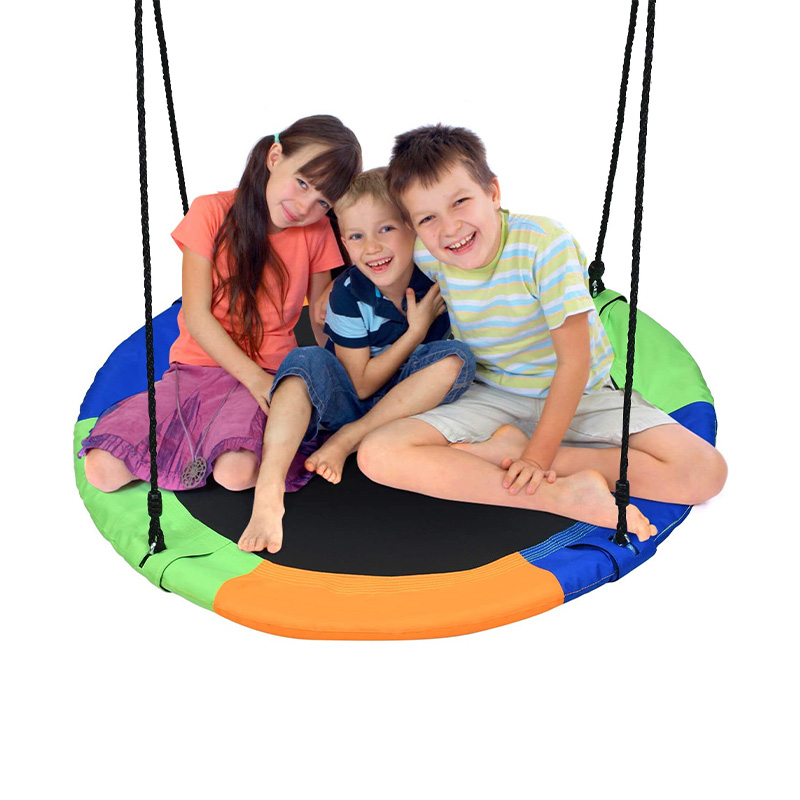 40-Inch Giant Oxford Saucer Swing for Inclusive PlayThis wide, multi-colored saucer swing supports several children at once, making it ideal for inclusive playgrounds. Its waterproof, tear-proof fabric suits outdoor use, and the flat surface allows sitting or lying.View Product →
The surface under this swing must be designed for the full fall height of the suspension point, and the accessible route connecting it to the rest of the playground must stay clear of loose debris and standing water.
How Surface Choice Interacts with Equipment and Fall Zones
Surface performance and equipment choice are connected in ways that are easy to overlook. Every piece of equipment has a defined use zone, and the surface inside that zone must meet ASTM F1292 for the equipment critical fall height. For a swing, the use zone extends in front of and behind the frame for a distance equal to twice the height of the suspension point. For climbing structures and slides, the surface must cover the perimeter of the structure plus an additional 72 inches. The same logic applies to safe and durable climbing systems, where the surface rating has to match the highest point a user can reach.
Maximum critical fall height by surface type at standard installed depth
When you compare maximum critical fall heights, the differences between bound and loose-fill surfaces become visible. The column chart shows typical maximum critical fall heights for the six surface types at their commonly installed depths. Poured-in-place rubber and engineered wood fiber both reach 12 feet, which covers almost all residential and many commercial play structures. Rubber tiles, bonded rubber, rubber mulch, and synthetic turf typically peak at about 10 feet, which is sufficient for platforms up to that height but not for tall modular decks. The height limit is not a fixed property of the material; it depends on the installed depth and the density of the product. A surface that handles a 6-foot fall does not automatically protect a child from a 10-foot fall, even when the same material is installed thicker and tested separately.
Once the surface is selected, the equipment has to perform its part. A swing frame in a high-traffic public area should be strong enough to support constant use without loosening; heavy-duty frames with a baked-on protective finish resist corrosion and stay stable on the compacted base below the surface.
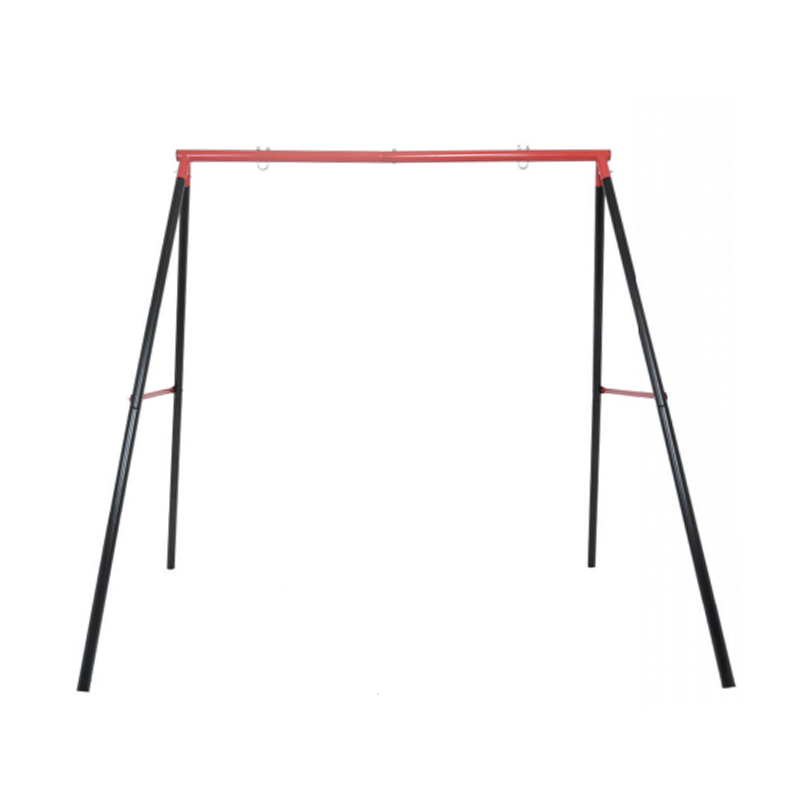 Heavy-Duty Rust-Proof Double Swing Frame for Public UseBuilt with thickened steel tubes and UV-resistant coating, this A-frame supports constant use in parks or schools. Its anti-tipping design keeps dual swings stable, matching the surfacing requirements discussed above.View Product →
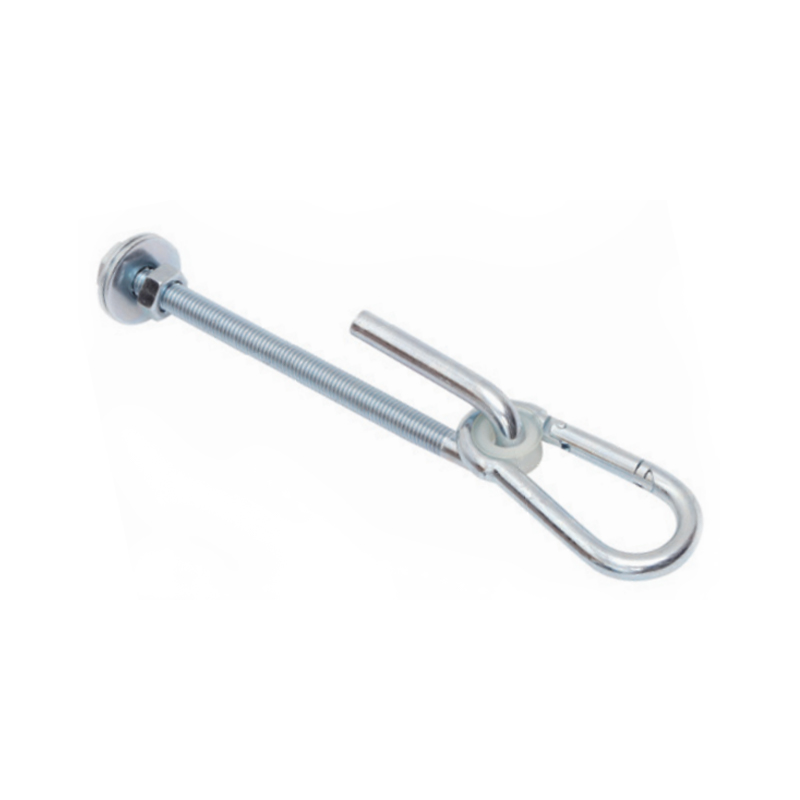
Anchoring method also depends on the surface choice. In loose-fill surfaces, support posts must be buried deeper and secured with anchors so the structure does not shift when the fill settles. In bound surfaces, posts are typically set in concrete footings and the topping is formed around them. A ground anchor kit with galvanized stakes holds buried posts in position and prevents the rocking that creates cracks in poured-in-place rubber.
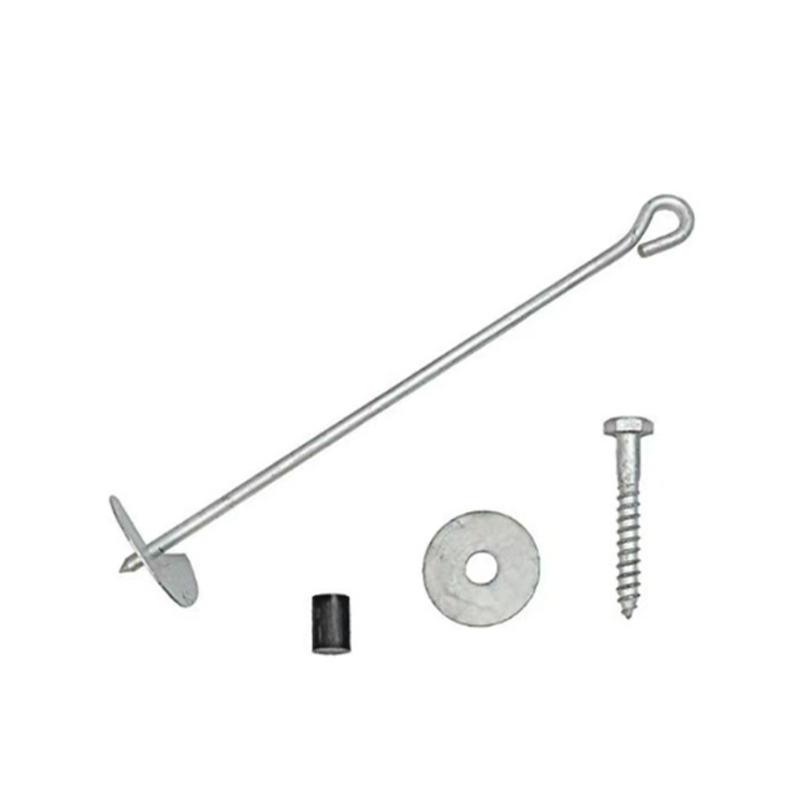 Electro-Galvanized Ground Anchor With Stakes for Hard GroundFeaturing a sharp cutting plate and extended body, this anchor secures posts in compacted soil. It directly addresses the anchoring needs described, preventing rocking and cracks in playground surfaces.View Product →
Get the anchoring wrong and no surface in the world will save the installation from failing inspection.
Installation and Site Preparation Tips That Protect Compliance
Surface material selection is only half the project. The same product can pass or fail a test depending on how the base is prepared and how the material is installed. Contractors who build ADA compliant playground surfaces on a regular basis follow a set of practices that protect the compliance of the finished site.
- Establish positive drainage away from the equipment so water never pools on the accessible route.
- Compact a stable sub-base of aggregate to prevent settling of the surface above.
- Install edging around loose-fill surfaces to keep material inside the use zone and reduce contamination with soil and debris.
- Verify the uncompressed depth of loose fill after installation, and require a written report that ties the final depth to the F1292 test certificate.
- Inspect drainage outlets, membrane joints, and anchor covers at least twice a year.
- For high-traffic areas, order a thicker bound surface system to raise the safety margin above the critical fall height.
These practices matter most in regions with freeze-thaw cycles, where subsurface water can lift tiles and crack poured-in-place rubber. If you are overseeing a public bid, ask the installer for a written warranty covering the bond between the surface and the base. For questions about how specific equipment interacts with new surfacing, talk with your manufacturer before the work starts.
Final Recommendations
Bringing all this information together, the decision framework can be stated in a few direct points.
- Choose poured-in-place rubber when the site is public, heavily used, and the maintenance budget cannot cover frequent attention.
- Choose engineered wood fiber only when you have dependable staff to rake, top up, and re-compact the surface at least twice per season.
- Choose rubber tiles when you need a firm, accessible surface but want to replace individual damaged pieces without site-wide repair.
- Choose bonded rubber as a middle ground between cost and durability for mid-use school sites.
- Choose synthetic turf when appearance matters more than initial cost and the base design can handle drainage.
Whichever surface you choose, verify the F1292 and F1951 reports for the exact product depth, make sure the installation includes proper drainage and edging, and schedule a compliance review after the first full year of use. The most expensive surface can become noncompliant if maintenance disappears, and the cheapest surface can pass inspection if the maintenance plan is real. A playground that is safe and accessible for everyone is the result of matching the surface, the equipment, and the people who care for it.